
The deadline for submitting annual financial statements is approaching, and the formal requirements have changed: the new RDF system starting in February 2026, the requirement for electronic signatures on resolutions, and challenges for foreign nationals without a PESEL number. We explain step by step who signs what, with what type of signature, and through which system.
Where and how do I file financial statements using Form KRS?
The financial statements consist of exclusively electronically — It is not possible to file it in paper form or in person at the registry court. There are two options available:
- RDF (Financial Documents Repository) — a free ICT system, accessible through the Court Registers Portal (prs.ms.gov.pl). From February 23, 2026. A new RDF system, integrated with PRS, is now operational, replacing the previous eKRS platform. To file a free application, at least one person authorized to represent the entity must have a PESEL number listed in KRS.
- S24 — a platform for the electronic registration of companies and the submission of applications to KRS. Filing financial statements via S24 is paid (140 zł — court fee, including publication in the Court and Economic Gazette). Used when the free RDF path is not available—e.g., when none of the members of the management board has PESEL in KRS.
The report itself is prepared in logical structure (XML) in a format specified by the Ministry of Finance. This is not a regular PDF file—it is a structured data document generated by financial and accounting software or the Ministry of Finance’s free “e-Financial Reports” application. The completed XML file is then signed by authorized individuals and uploaded to the system.
Who must sign the financial statements, and what kind of signature is required?
The Accounting Act identifies two categories of persons required to sign the financial statements:
- Unit manager — in the case of a board with multiple members, as a general rule all members of the board of directors.
- Bookkeeper (chief accountant, chief financial officer, or a person from the accounting firm that maintains the company's books).
However, a simplification has been in effect since 2022 (Article 52(2b)): in the case of a board with multiple members, a single signature is sufficient one member of the board of directors, provided that the other members submit statements certifying that the report meets the requirements of the Act. The statements (electronic or on paper with a handwritten signature) must be attached to the report.
Each of these individuals signs the report on an individual basis, one of the acceptable types of signature:
| Signatory | Valid signature | Comments |
|---|---|---|
| Board member from PESEL to KRS | QES (qualified electronic signature) / trusted signature / personal signature | Free RDF track |
| Board member without PESEL in KRS (foreign national) | QES (qualified electronic signature) | S24 (140 zł), when no one on the board holds PESEL in KRS |
| Bookkeeper | QES / trusted signature / personal signature | PESEL is required only for trusted and personal signatures |
| Receiver / Liquidator (instead of the board of directors) | As above | In accordance with the position held |
Qualified Electronic Signature (QES) in accordance with the eIDAS Regulation (EU) No. 910/2014 has the same legal effect as a handwritten signature (Article 25(2)) and is recognized in all EU countries (Article 25(3)). For a foreign national without a PESEL number, this is the only signature accepted in all eKRS/RDF systems.
If you're wondering about the difference between the various types of signatures, read: Differences Between a Trusted Profile and a Qualified Electronic Signature.
What's New in 2026? The New RDF System and the Requirement for Electronic Signatures on Resolutions
The year 2026 brought two significant changes that many companies are not yet aware of:
1. The new RDF system, effective February 23, 2026.
February 23, 2026. A new Financial Documents Repository (RDF) has been launched, and as of March 13, 2026. It is fully integrated with the Court Registers Portal (PRS). The previous eKRS platform no longer supports new submissions. The new system has changed the interface, the login process, and the document submission process—if your company was using the old instructions, please update them.
2. Resolutions must be signed electronically—scans are no longer sufficient
This is the most important practical change: resolutions of the shareholders' meeting or the general meeting (approval of the financial statements, distribution of profits, or coverage of losses) must be signed with an electronic signature. A scan of the paper minutes or resolution alone is no longer sufficient—the new RDF system rejects documents without an electronic signature, even though the regulations (Article 19e of the KRS Act) have not changed.
In practice, the resolution is either drafted electronically from the outset, or a scan of the paper document is signed with an electronic signature by the authorized person submitting the filing (e.g., a member of the management board under PESEL in KRS). For board members who are foreign nationals—and who do not have access to a trusted digital signature—the only realistic option is qualified electronic signature (QES).
Free RDF or paid S24—which option should you choose?
The choice of path depends primarily on the composition of the board of directors and whether any of its members have a PESEL number disclosed in KRS:
| Criterion | Free RDF Registration | Paid S24 (140 zł) |
|---|---|---|
| Required condition | At least 1 person from PESEL in KRS | No condition regarding PESEL |
| Fee | None | 140 zł (court fee and notice in MSiG) |
| Typical application | Companies with a Polish management team or a mixed management team | Companies with a management board composed exclusively of foreign nationals without PESEL in KRS |
| Accepted signatures | QES / trusted signature / personal signature | QES / Trusted Signature |
| Speed | An entry in KRS is posted automatically after the report is verified | The application is reviewed by the registry court |
How can a foreigner without a PESEL sign the report?
This is one of the most common problems in companies with foreign capital or management. A foreign national without a PESEL number:
- cannot obtain a trusted profile (Trusted Profile requires PESEL),
- cannot use a handwritten signature (requires a Polish e-ID),
- may sign only with a qualified electronic signature (QES).
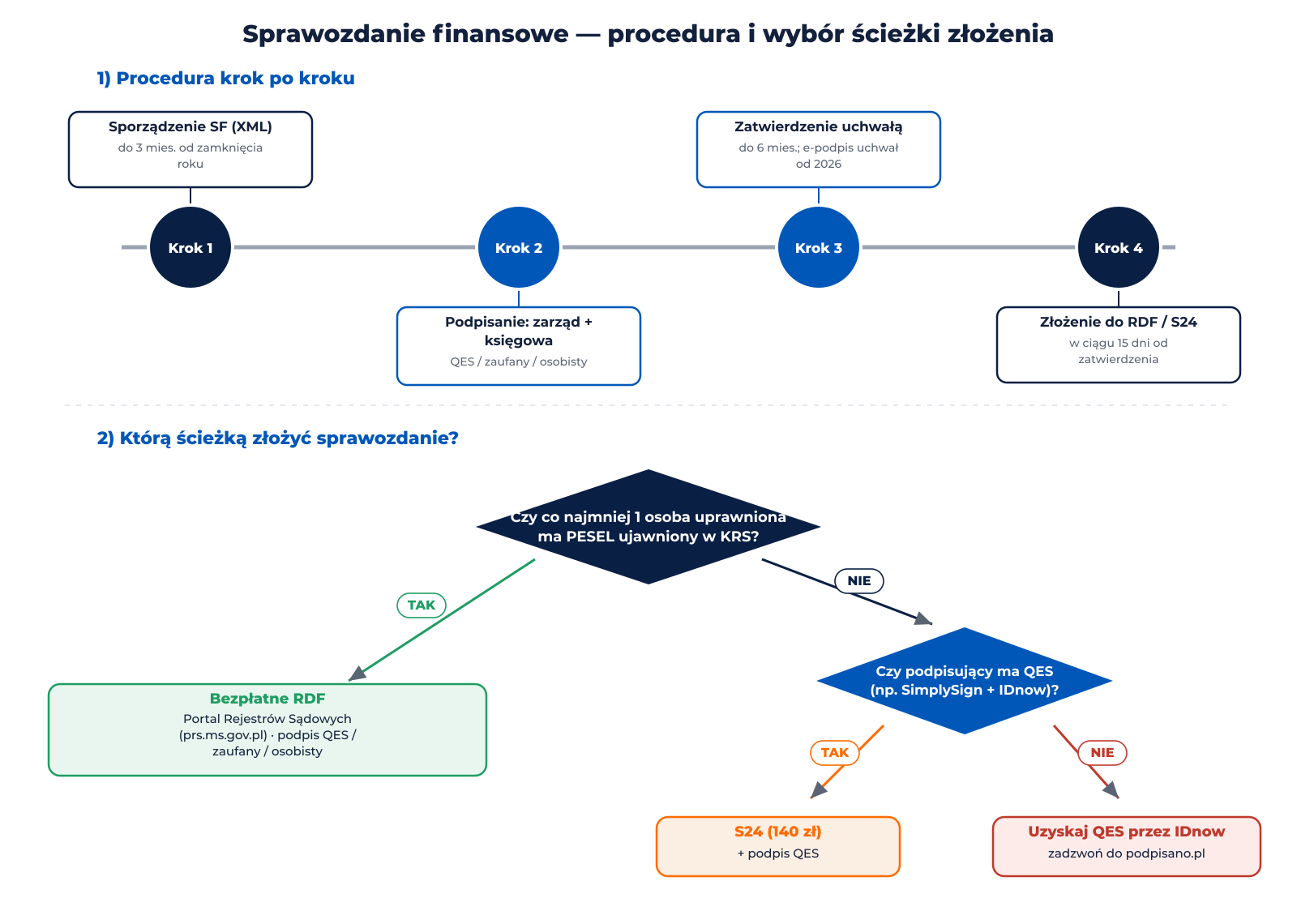
At the same time—a foreign national who is a member of the management board, whose PESEL is not disclosed in KRS, cannot file the report on its own through the free RDF system. In that case, the company files it through S24 (a fee-based application, 140 zł) or through an authorized representative—an attorney or legal advisor—who can file the report for free via the RDF system. When another member of the management board from PESEL initiates the filing in the RDF, the foreign national simply signs the documents with their QES.
How does a foreign national obtain a QES in Poland?
A qualified electronic signature is issued based on identity verification. Foreign nationals can undergo the remote video verification process IDnow — without an in-person visit. At podpisano.pl, we offer a customized solution: SimplySign QES for Foreign Nationals with IDnow — a mobile qualified digital signature accepted by all systems in Poland and throughout the EU.
You can read more about this process in the article: How can a foreign national obtain a qualified electronic signature online in Poland?
This same group of companies often also has responsibilities related to KSeF — see: Invoicing Integration with KSeF — Qualified Digital Seal and Permissions.
What is the step-by-step procedure?
The procedure for filing financial statements is as follows—the order is important:
- Preparation of Financial Statements in a logical format (XML)—using financial and accounting software or the free “e-Financial Reports” application from the Ministry of Finance. Deadline for preparation: generally, 3 months from the end of the fiscal year (for companies with a calendar year—for 2025, by March 31, 2026).
- Signing of the report by the board of directors and the chief accountant/bookkeeper — Each person signs the XML file with a qualified electronic signature, a trusted signature, or a personal signature. In the case of a board with multiple members, the signature of a single board member is sufficient if the others have submitted the required statements (see above).
- Approval of the report by a resolution of the meeting — The shareholders’ meeting or general meeting approves the financial statements and adopts a resolution on the distribution of profits or the coverage of losses. Approval deadline: 6 months from the end of the fiscal year (for companies with a calendar year — by June 30, 2026). Resolutions must bear an electronic signature — The new RDF does not accept scans alone.
- Submission to RDF — through the Court Registry Portal (free of charge if condition PESEL is met) or through S24 (for a fee of 140 zł). Filing deadline: 15 days from the date of approval of the report—if approved on June 30, 2026, at the latest July 15, 2026.
- Confirmation of Receipt — The system generates a confirmation of document submission. Keep it as proof that you fulfilled your obligation on time.
Which signature should I choose: SimplySign or Certum Mini?
For those who sign financial statements, the key criteria are convenience, Compatibility with the RDF/eKRS system and — for foreign nationals — the possibility of obtaining it without PESEL.
| Feature | SimplySign (mobile QES) | Certum Mini (card + reader) |
|---|---|---|
| Certificate medium | Cloud (mobile app or API) | Cryptographic card + USB reader |
| Identity Verification for Foreign Nationals | Remotely (IDnow online, video) or in person | In-person visit to a service center or remote (IDnow online, video) — in that case, however, the card must be physically delivered |
| Browser-based access | Yes (SimplySign Web) | Yes (with the driver installed) |
| Acceptance in RDF/eKRS | Yes | Yes |
| Timestamps | Available, 5,000 per month | 5,000/month included (Certum Mini) |
| Ideal for | Foreigners, field staff, rapid deployments | Intensive in-person signers |
Both solutions are available at podpisano.pl — an authorized Certum partner. If you're not sure which option is right for you, read the comparison: SimplySign or Certum Mini — When to Choose the Right Solution.
Summary
The filing of financial statements for KRS in 2026 is entirely electronic and—with proper preparation—runs smoothly. The key is choosing the right signature and knowing the filing process that matches the composition of the board of directors.
- ✅ The report (XML file) is signed by the bookkeeper and the board of directors — a qualified electronic signature, a trusted signature, or a personal signature; starting in 2022, the signature of a single board member will suffice if the others submit statements.
- ✅ Resolutions must bear an electronic signature — The new RDF system does not accept paper scans of minutes alone.
- ✅ A foreigner without PESEL signs only QES (with a qualified electronic signature), and the report is submitted to KRS via S24, through a professional representative, or via RDF—when the submission is initiated by another member of the management board from PESEL.
Do you need help?
As authorized partner Certum We help Polish and foreign companies equip their management boards with qualified digital signatures ready for signing and filing financial statements—including through remote IDnow verification for foreign nationals.
Call us at: +48 22 417 05 55 — We can provide advice at our offices in Warsaw, Kraków, Wrocław, and Radom, or online.
Check out the offer:
- SimplySign — Mobile QES — for Polish members of the board of directors
- SimplySign QES for Foreign Nationals (with IDnow) — remote verification, starting at 299 zł + 2,100 zł for IDnow
- Certum Mini qualified electronic seal — a qualified electronic seal for a company (e.g., for KSeF)
For more information about the RDF system, visit: ekrs.ms.gov.pl i prs.ms.gov.pl.
Frequently Asked Questions (FAQ)
How do I sign and file financial statements using the KRS form?
Financial statements must be filed exclusively electronically via the Financial Documents Repository (RDF) on the Court Registers Portal or through the S24 system. Prepared in XML format, they must be signed by the person responsible for maintaining the accounting records and by the management board — all members or, starting in 2022, at least one member, provided the others submit declarations — using a qualified electronic signature (QES), a trusted signature, or a personal signature. The free RDF submission process requires that at least one authorized person have a PESEL number disclosed in KRS.
Do all members of the board of directors have to sign the financial statements?
As a general rule, yes—the financial statements must be signed by all members of the management board and the person responsible for maintaining the accounting records. However, starting in 2022, the signature of a single member of the management board will suffice if the others submit statements confirming that the report meets the requirements of the Accounting Act (Article 52(2b)). A refusal to sign or make such a statement must be accompanied by a written justification attached to the report.
What about a foreign national on the board of directors who does not have a PESEL number?
A foreign national without PESEL cannot use a trusted profile or a personal signature. The only available option is qualified electronic signature (QES). It can be obtained remotely through the IDnow service (video verification, without a visit to Poland). The report is submitted to KRS via S24 (for a fee of 140 zł), through a representative (attorney or legal advisor), or—if another member of the management board from PESEL initiates the filing with the RDF—the foreign national merely co-signs the documents with their QES.
When should financial statements be filed with KRS?
Financial statements must be prepared within 3 months of the end of the fiscal year, approved by resolution within 6 months, and filed with RDF or S24 within 15 days of approval. For the 2025 fiscal year, which coincides with the calendar year: preparation by March 31, approval by June 30, and submission no later than July 15, 2026.
Can scanned copies of paper resolutions be submitted to the RDF instead of electronically signed ones?
No. Resolutions approving the financial statements and the distribution of profits or coverage of losses must bear an electronic signature—the new RDF system rejects scans alone. A scan of a paper resolution must be signed with an electronic signature (e.g., the submitter’s QES) before it is sent.
What is the new RDF system, and how does it differ from the old eKRS?
The new Financial Documents Repository (RDF) has been operational since February 23, 2026, and has been fully integrated with the Court Registers Portal (PRS) since March 13, 2026. It has replaced the previous eKRS platform for the submission of financial documents. The new system features a revised interface and login process and integrates company registration data—financial documents are directly linked to the current KRS entry.


