
Thousands of invoices per month, integration with KSeF And what about the requirement for a reliable archive? We show how an IT department can automate the process of signing documents with a qualified digital seal via an API—from choosing a cloud-based solution to archiving with long-term validation.
What is a qualified digital seal, and what are its legal effects?
Qualified Electronic Seal (QSeal) This is a trust service regulated by the regulation eIDAS (EU Regulation No. 910/2014). Unlike a qualified digital signature, which identifies an individual, the stamp contains the following information entity — the company name and the number NIP (Tax Identification Number). This is the digital equivalent of a company stamp, except that it is cryptographically linked to the document's content.
The most important thing for a business is Art. 35 eIDAS:
- A qualified seal uses presumption of data integrity and authenticity of origin data to which it relates—the party challenging the document must prove that it has been altered or does not originate from the company,
- stamps legal effect cannot be denied or its admissibility as evidence in court simply because it is in electronic form,
- A qualified seal from a single EU country is recognized in all other.
In practice: A stamped PDF invoice serves as proof that your company issued it and that no one has altered the amount or invoice number—any modification is detectable during validation.
Seal does not replace a declaration of intent — Contracts are still signed by authorized individuals; the seal confirms the origin and integrity of documents „produced” by the organization. Read more about this division of roles in the articles Stamp or qualified signature for KSeF? The short decision and Signature, Seal, and Timestamp — How Digital Trust Services Work.
How can I automate the stamping of thousands of invoices via an API?
The key to automation is a stamp that can be invoked in terms of programming. Certum offers a qualified digital seal in the following variant cloud-based (SimplySign) — without a card or reader — and in the version HSM (Hardware Security Module) for the largest volumes. Both options can be linked via API (Application Programming Interface) with class-based systems ERP (Enterprise Resource Planning), EZD (Electronic Document Management), CRM, or with your own invoicing software.
The process is simple: the invoicing system generates a document, sends it via API to the sealing service, which applies a qualified seal (and, optionally, a qualified timestamp), and the stamped file returns to the workflow—to be sent, uploaded to the customer portal, and archived. The entire process takes place without human intervention, in the background, even at night and on weekends — this is the key difference from a signature, which requires authorization by a specific person.
In the podpisano.pl lineup, you'll find Qualified Seal SimplySign — a cloud-based solution, ready for API/ERP integration, with a 1-, 2-, or 3-year certificate. We price bulk sealing (including the HSM option) on a case-by-case basis, depending on volume and system architecture—which is why you won’t find „off-the-shelf” API limits or pricing plans: we tailor them to your scale.
In what formats are documents stamped?
Seals fall into the same format families as electronic signatures:
- PAdES — a stamp embedded in a PDF file; the natural choice for displaying invoices and documents to customers,
- XAdES — for XML files and structured data; this format is also used for authentication in the KSeF API,
- CAdES — for any binary files (e.g., document packages).
Each format has profiles that include validation data and archival tags (all the way up to LTA long-term profiles)—we’ll come back to these when discussing archiving. The article explains the differences Internal vs. External Signatures — CAdES, XAdES, or PAdES?.
A stamp on a card or in the cloud—which should you choose for automation?
| Feature | Stamp on the card (Certum Mini) | Cloud Seal (SimplySign) / HSM |
|---|---|---|
| Key carrier | cryptographic card + reader | Certum cloud / HSM module |
| Directions for Use | at the workstation, on a computer with a card reader | through the app or API — without human intervention |
| Scale | individual documents and smaller batches | bulk, automatic stamping |
| Integration with ERP/EZD | limited (physical card at the workstation) | Full — API, background processing |
| Timestamps | package 5,000 units/month. in podpisano.pl | Selecting a package based on volume (pricing) |
| Price in podpisano.pl | from 1,399 PLN | from 1,289 PLN |
| Who is it for? | office/secretariat, small volume | IT departments, bulk invoicing, KSeF via API |
Conclusion: For automation, choose the cloud or HSM option. The card requires the user to be physically present at the workstation—it’s ideal for situations where documents are stamped one at a time, such as. Certum Mini qualified electronic seal with a package of 5,000 timestamps per month. When invoices are generated by the ERP system in the thousands, the key must be available to the server application—and only the cloud or an HSM can ensure this.
How does a qualified seal work in KSeF?
KSeF (National e-Invoice System). is mandatory as of February 1, 2026. for taxpayers with sales exceeding 200 million PLN (for 2024), and starting from April 1, 2026. — for all other companies, including those exempt from VAT. When there’s a large volume of invoices, no one enters them manually into the ministry’s application—this is done by an ERP system connected to API KSeF 2.0. And this is where the seal plays a key role.
The company's NIP seal is a method of automatically authenticating an entity in KSeF. This means that:
- The company as a whole „logs in” to KSeF, not a specific employee—the process is not dependent on vacation time, staff turnover, or anyone’s personal certificates,
- The company is not required to file a notice ZAW-FA, which identifies a natural person—the seal provides authentication at the entity level,
- After the document has been certified with a seal, the company may download KSeF certificate (free, valid for up to 2 years): Type 1 is used to authenticate API sessions — interactive and batch — a Type 2 for tagging invoices with a QR code in offline modes,
- current token KSeF works only until December 31, 2026. — Token-based integrations must be switched to certificates by that time.
📌 An important point to note: in KSeF Individual invoices are not stamped. A structured (XML) invoice does not bear the issuer’s signature or seal—the seal serves as authentication session, in which the system sends out even thousands of invoices. Bulk file stamping applies to documents besides KSeF (more on this below).
We describe how to integrate this into an ERP system and how to manage permissions in our articles Qualified seal (QSeal) — required in KSeF and Secure KSeF — A Guide to ERP Integration.
What else is worth mass-stamping besides KSeF?
Since invoices in KSeF aren’t stamped, where is the mass stamp actually used? Anywhere the company issues documents externally or archives them internally:
- Invoice previews (PDF) sent by email or made available on the customer portal — the seal prevents the invoice number from being altered (a classic „invoice fraud” scheme),
- B2C invoices — Consumer sales do not have to be recorded in KSeF, and the customer should receive a document guaranteeing authenticity,
- balance confirmations, payment demands, accounting memos, reports, certificates, and policies — bulk financial and formal correspondence,
- Digitization of employee records (e-files) — Digital copies must be affixed with the employer’s authorized seal or signature.
If the stamped documents are also to be sent to recipients via a channel that has the legal force of registered mail, combine the stamping process with shipping via e-Delivery — mailbox e-Delivery Enterprise also provides API for bulk sending and integrates with the same document workflow.
Why are qualified time stamps required for invoices?
A stamp answers the questions „Does this document come from the company?” and „Has anyone altered it?” However, it does not answer the question „When did it exist?”. This is the task qualified time stamp: in accordance with Article 41 eIDAS he benefits from the presumption the accuracy of the displayed date and time and data integrity, with which that date is linked, and which has legal effects under Polish law date certain as defined in the Civil Code.
In bulk invoicing and archiving, the timestamp serves three functions:
- proves that the document existed at that time — puts an end to disputes over the backdating of invoices, addenda, or demand letters,
- extends the validity of the seal — demonstrates that the seal was affixed while the certificate was valid, even if it has long since expired,
- creates archival profiles (LTV/LTA), without which a long-term archive of electronic documents loses its evidentiary value.
With thousands of documents, volume is what counts: the items listed on the podpisano.pl form—like the Certum Mini stamp—include 5,000 valid timestamps per month, and for cloud stamping and API integrations, we select the tag package based on the actual volume as part of the pricing. The basics of how tags work are explained in the article Electronic timestamp — what it is and how it works.
How should stamped documents be archived for long-term storage (LTV/LTA)?
The seal certificate is valid for 1–3 years, while you retain invoices and accounting documents for much longer (KSeF retains structured invoices for 10 years, but visualizations, contracts, or e-files outside of KSeF are the company’s responsibility). What happens if, after eight years, an auditor wants to verify a seal based on a certificate that expired in 2027?
The answer is long-term validation:
- LTV (Long-Term Validation) — A complete set of validation data (certificates, CRLs/OCSP responses) is attached to the document, ensuring that verification will not depend on the availability of online services several years from now,
- LTA (Long-Term Archival) — the document is regularly „stamped” with successive archival timestamps, before cryptographic algorithms become weaker; this is how the XAdES-A and PAdES-LTA profiles work.
In a mass trial, this means one thing: The seal profile and tag refresh policy are set during the API integration phase, rather than years later. eIDAS 2.0 (Regulation 2024/1183) has, in fact, added it to the list of trust services qualified electronic archiving — The e-document archive is becoming a service based on a defined EU standard. You can find the practical guidelines in the guide How to secure a document for years to come? Preservation of electronic signatures in practice.
Step-by-Step Guide to Implementing Automatic Stamping
What does a model implementation look like in a company that handles a large volume of documents?
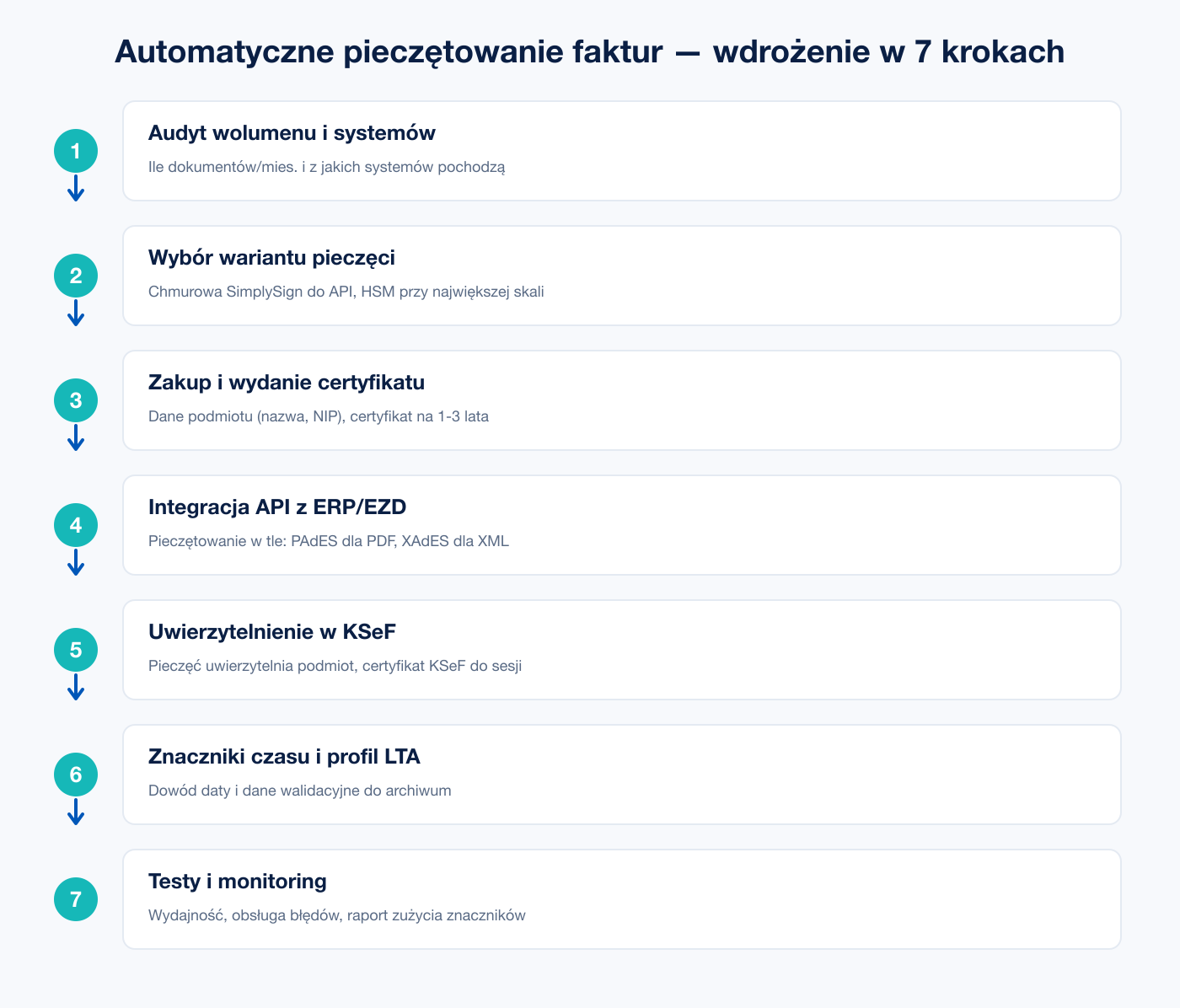
- Audit the volume and sources of documents — How many files per month, from which systems (ERP, invoicing, HR), and which ones require a seal and which ones only require authentication in KSeF.
- Select a seal option — SimplySign cloud solution for API integration; HSM for the largest scale; card for desktop use only.
- Gather the registration documents and order a seal — The certificate is issued in the entity's name (name, NIP); you can find the list of documents in the article Documents to make a qualified electronic seal.
- Integrate the sealing service via API — with an ERP/EZD system or invoicing software; set the formats (PAdES for PDF, XAdES for XML) and the destination profile right from the start with LTV/LTA in mind.
- Configure authentication on the KSeF — authenticate the entity with a seal, obtain a Type 1 KSeF certificate for API sessions (and a Type 2 certificate for offline modes), and plan to phase out tokens by the end of 2026.
- Add timestamps and an archiving policy — Select a tag package based on the volume and refresh schedule of the archived profiles.
- Test and monitor — performance, error handling, alerts, and a token usage report; only then should you deploy it to production.
Summary
Bulk invoicing and document workflow automation require a tool that operates without human intervention while still providing strong legal validity. A qualified electronic seal—whether cloud-based or HSM-based—integrated with an ERP system via an API meets both of these requirements.
- ✅ A stamp identifies a company, not an individual — The document is presumed to be complete and authentic in terms of its origin (Article 35 of eIDAS), and the process does not depend on any single employee.
- ✅ For automation, choose the cloud option (SimplySign) or HSM with API — The card is only suitable for desktop use; in KSeF, the seal automatically authenticates the entity in API sessions, without ZAW-FA.
- ✅ The seal itself isn't everything — Qualified time stamps (5,000 per month in podpisano.pl packages) and LTV/LTA profiles ensure that the archive retains its evidentiary value for years.
Do you need help?
As authorized partner Certum We help companies with high document volumes choose the right seal option (cloud or HSM), plan API integration with their ERP system, and configure authentication in KSeF. We price limits, timestamp volumes, and the implementation model on a case-by-case basis—tailored to your scale.
Call us at: +48 22 417 05 55 or write to us at: [email protected]. You can find us at our offices in Warsaw, Katowice, Kraków, Wrocław, and Radom — or online and at a location of your choice.
Related products:
Frequently Asked Questions (FAQ)
How can you automate the process of stamping thousands of invoices with a qualified seal?
Select a qualified digital seal in the cloud-based version (e.g., SimplySign through Certum) or HSM, and integrate it via API with your ERP system or invoicing software. The system automatically stamps documents in the background in PAdES/XAdES/CAdES formats, and each file can also be assigned a qualified timestamp. Volumes and the implementation model are determined as part of an individual quote.
Does a qualified digital seal allow a company to be authenticated in KSeF without ZAW-FA?
Yes. A qualified digital seal containing the company’s NIP is a method of automatically authenticating the entity in KSeF—the company does not need to file a ZAW-FA notification identifying a natural person. After authentication with the seal, the company can also download a free KSeF certificate (valid for up to 2 years) for ongoing use in API sessions.
Is it necessary to stamp every invoice in KSeF?
No. A structured (XML) invoice in KSeF is not signed or stamped by the issuer—the stamp authenticates the API session during which the system sends multiple invoices. Bulk sealing applies to documents outside of KSeF: PDF previews for customers, B2C invoices, balance confirmations, reports, and digitized employee files.
On-premises or cloud-based—which is better suited for automation?
Only the cloud seal (SimplySign) or the HSM module is suitable for automation and API integration—the key is available to the server application. The card-based seal (Certum Mini) requires a reader at the workstation and is suitable for smaller volumes; the podpisano.pl package includes 5,000 timestamps per month.
Why include a timestamp on an invoice if there's already a stamp?
A seal confirms the origin and integrity of a document, but does not prove when it existed. A qualified time stamp relies on the presumption of date accuracy and data integrity (Article 41 of eIDAS) and has the legal effect of a certified date. In archiving, it also allows the validity of the seal to be demonstrated after the certificate has expired—this is the foundation of LTV/LTA profiles.


